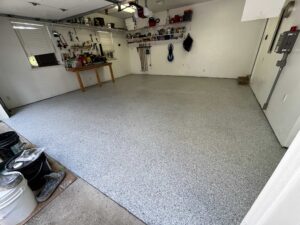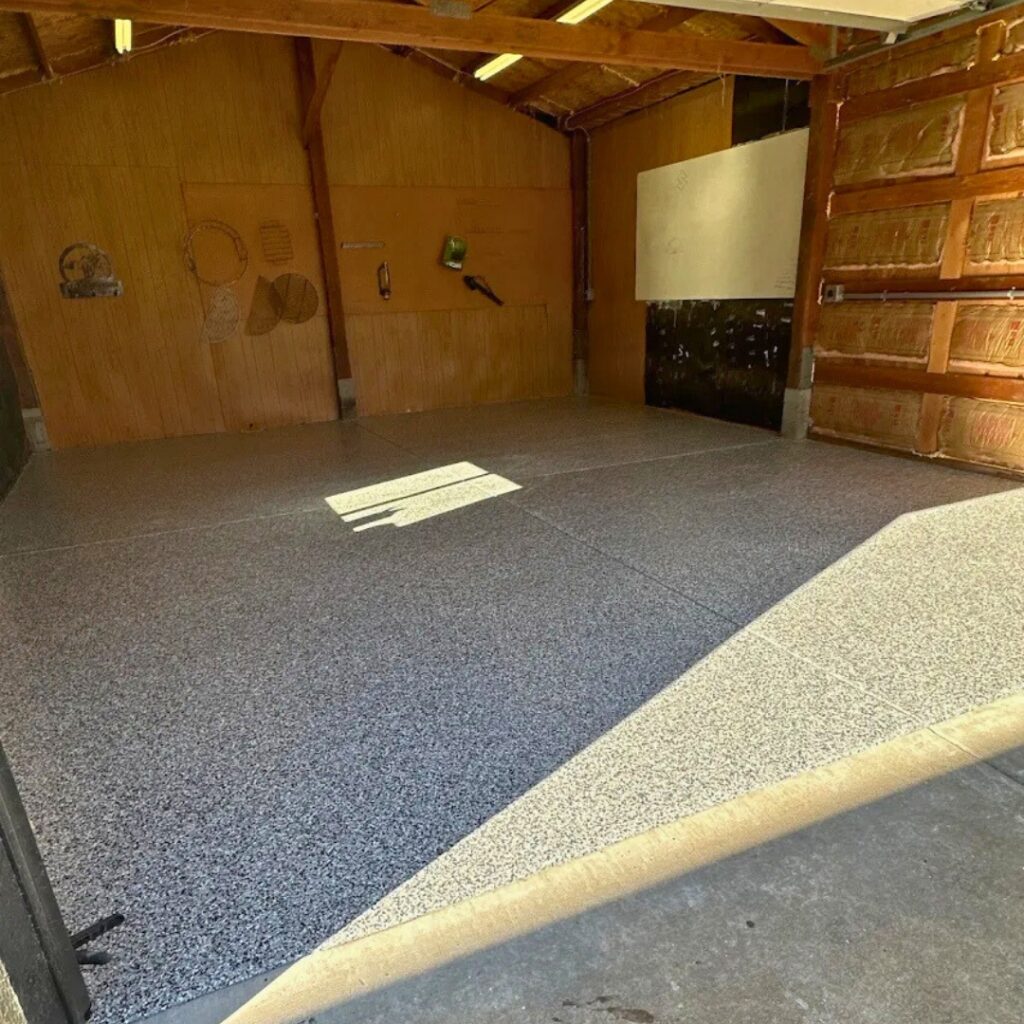
Short answer: most garage floors in good structural shape are ready for epoxy garage floor prep and coating as-is. The 5 things to check are slab age, moisture, cracks and damage, existing coatings, and oil or chemical stains. If your slab is at least 28 days old, structurally sound, and your only issues are cosmetic, you are likely ready to schedule. The heavy prep work like diamond grinding, crack repair, and moisture mitigation is handled by us during install, following the same coating system on every job. Your job is to walk the floor once with this list, clear the space, and flag anything unusual so we can plan around it. Full breakdown below.
The bottom line: a small list of structural issues will pause a coating project. Almost everything else is cosmetic and is solved during professional epoxy garage floor prep on install day.
1. Slab Age: Is the Concrete Fully Cured?
Fresh concrete cannot be coated. New slabs release moisture vapor for weeks after the pour, and any coating applied too early will trap that moisture and blister, bubble, or delaminate within months.
The 28-day rule: Concrete is generally considered cured at 28 days from the pour date. That is the minimum wait time before any garage floor coating goes down. For new construction in the Portland metro and SW Washington, we recommend 60 to 90 days when scheduling allows, since PNW concrete holds moisture longer than concrete in drier climates.
What to check: If your home was built or your garage slab was poured within the last 30 days, push the install date out. If you are not sure when the slab was poured, ask the builder or check your construction documents.
2. Moisture: Is Water Coming Up Through the Slab?
Moisture is the number one cause of coating failure across every climate. Vapor pushes up through concrete from the soil below, and if it has nowhere to go, it pushes coatings off the slab from underneath. The PNW makes this worse than most regions.
Warning signs to look for:
- White, chalky deposits on the concrete surface (this is called efflorescence — mineral salts left behind as moisture evaporates through the slab)
- Dark, damp-looking patches that never fully dry
- Water pooling on the slab after rain
- Musty smell when the garage is closed up
- Prior paint or coatings that peeled, bubbled, or turned milky
If any of these show up on your slab, do not skip telling your installer. A real coating contractor will run a moisture test with a meter during the estimate and apply a moisture mitigation coat if readings come back high, in line with ASTM F710, the industry standard for testing and preparing concrete floors before a coating goes down. This is not an upsell. It is what keeps the floor from peeling.
What to check on your end: Walk the garage on a wet morning and note any zones that stay damp. Photograph any white deposits (efflorescence), dark patches, or visible water seeps. Show your installer during the walkthrough.
3. Cracks, Spalling, and Surface Damage
Most slabs have some cracking. Hairline cracks at control joints and minor surface cracks are normal and routinely handled during epoxy garage floor prep with flexible polyurea filler. Major structural issues are a different story.
Routine (handled during install):
- Hairline cracks under 1/8 inch wide
- Control joints and expansion joints
- Minor surface dusting or chalking
- Light pitting from old impacts
These get filled, leveled, and coated over as part of our standard concrete crack repair process, guided by ICRI’s concrete surface preparation guidelines. No homeowner action needed.
Needs evaluation before coating:
- Cracks wider than 1/4 inch
- Cracks with vertical displacement (one side higher than the other)
- Active heaving or settling
- Large spalled areas where surface concrete has flaked off
- Trip hazards at the garage threshold
These can usually still be coated, but they may require concrete resurfacing or structural repair first. We will identify this during the estimate.
What to check: Sweep the floor and walk every square foot. Look for cracks wider than a credit card edge, any spot where the slab has settled unevenly, and any areas where the surface concrete has broken off in chunks.
4. Existing Coatings, Sealers, or Paint
If your garage floor has been painted, sealed, or coated before, the existing material almost always needs to come off before a new coating goes down. New coatings will not bond reliably to old paint, failed epoxy, or driveway sealer.
Common scenarios:
- Garage floor paint. Latex or oil-based paint applied with a roller. Needs full mechanical removal.
- DIY epoxy kits. Box-store epoxy kits that have peeled, yellowed, or developed hot tire pickup. Needs full removal of any failing areas. Well-bonded sections can sometimes be ground down and coated over.
- Concrete sealer. Penetrating or topical sealers applied by a previous owner. Sealers prevent bonding. They need to come off.
- Cure-and-seal compounds. Builders sometimes apply these on new slabs. They must be ground off before any coating.
What to check: Look for any color, sheen, or texture on the floor that does not look like raw concrete. Run a water test: drip water on the slab in several spots. If it beads up instead of soaking in, something is sealed on the surface. Tell your installer about any prior coatings, even if they look worn off.
The good news: full removal is part of what diamond grinding does.
5. Oil, Grease, and Chemical Stains
Garage floors live with oil drips, brake fluid, antifreeze, gasoline, and paint spills. These contaminants soak into porous concrete and create bond breakers that prevent coatings from sticking.
The good news: diamond grinding removes most surface staining. The bad news: heavily contaminated zones where oil has soaked deep into the slab may need extra prep, including degreasing, repeat grinding, or in extreme cases, a primer coat over the contaminated area.
What to check: Walk the garage and note where you have seen recurring oil drips, fluid spills, or paint marks. Particular focus on:
- Where the engine and transmission sit when the car is parked
- Where you do oil changes or vehicle work
- Around water heaters and HVAC equipment
- Old workbench or storage zones
Photograph anything heavy and show your installer. Knowing the slab’s history lets us plan prep time accurately and quote without surprises.
Epoxy Garage Floor Prep: What You Handle vs. What We Handle
A lot of homeowners worry they need to scrub, etch, or repair their concrete before we arrive. You do not. Real epoxy garage floor prep is our job, not yours. Here is the actual split.
Your job before install day:
- Clear everything off the floor (vehicles, shelving, bins, tools)
- Move freestanding storage to the driveway or another space
- Flag any moisture, damage, or prior coating issues during the estimate
- Make sure we can access power and water
- Plan parking elsewhere for 24 to 48 hours
Our job on install day:
- Mask off walls and adjacent surfaces
- Diamond-grind the entire slab with HEPA-filtered grinders
- Repair cracks and joints with flexible polyurea filler
- Test for moisture and apply mitigation if needed
- Apply the polyurea basecoat
- Broadcast vinyl flake
- Scrape, vacuum, and topcoat with UV-stable polyaspartic
For the full process breakdown, see our coating systems page and our post on how long a garage floor coating takes to install.
The Homeowner Pre-Install Checklist
If you are scheduled for an install and want to make sure things go smoothly, here is the short version:
- One week before: Start clearing the garage. Set up driveway tarps for items that need to stay outside.
- Two days before: Move vehicles out. Move the last items off the floor.
- Day of install: Crew arrives early, garage door stays open during prep, plan to be flexible with home access for water and power. Pets and small kids should stay out of the garage during install.
- Day after install: Light foot traffic is fine. Hold off on moving heavy items back in.
- 48 hours after install: Vehicles can return. Drive in slowly.
Signs Your Slab Might Need Resurfacing Before Coating
In rare cases, the concrete itself needs work before a coating makes sense. Look for these red flags:
- Large sections of the surface have crumbled or flaked away (spalling beyond cosmetic)
- The slab has heaved unevenly with visible vertical displacement at cracks
- Active water intrusion or standing water that does not drain
- The slab is structurally unsound or has been partially replaced
If any of these are present, our crew will walk you through concrete resurfacing or repair options first, then coat the rebuilt surface. We will not put a coating over a slab that is not ready, because we want every install to last. If durability questions are on your mind too, our guide to how long polyaspartic garage floors last covers what actually shortens or extends that lifespan.
Get Your Slab Evaluated for Coating
In-Home Slab Evaluation From a Family-Owned Cedar Hills Crew
Complete Coatings NW is a family-owned concrete coatings company headquartered in Cedar Hills, OR, serving Portland, Vancouver, Beaverton, and the surrounding Portland metro and SW Washington. Every estimate includes a real walkthrough of your slab, moisture testing with a meter, and an honest answer on whether your floor is ready for epoxy garage floor prep or needs other work first. Call (971) 247-9844 or request your in-home estimate and we will tell you exactly what your floor needs and what it will cost. Curious about pricing first? See our breakdown of garage floor coating cost in the Portland area.