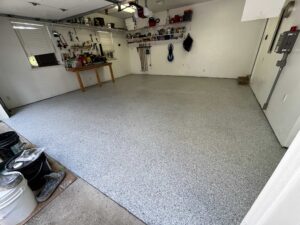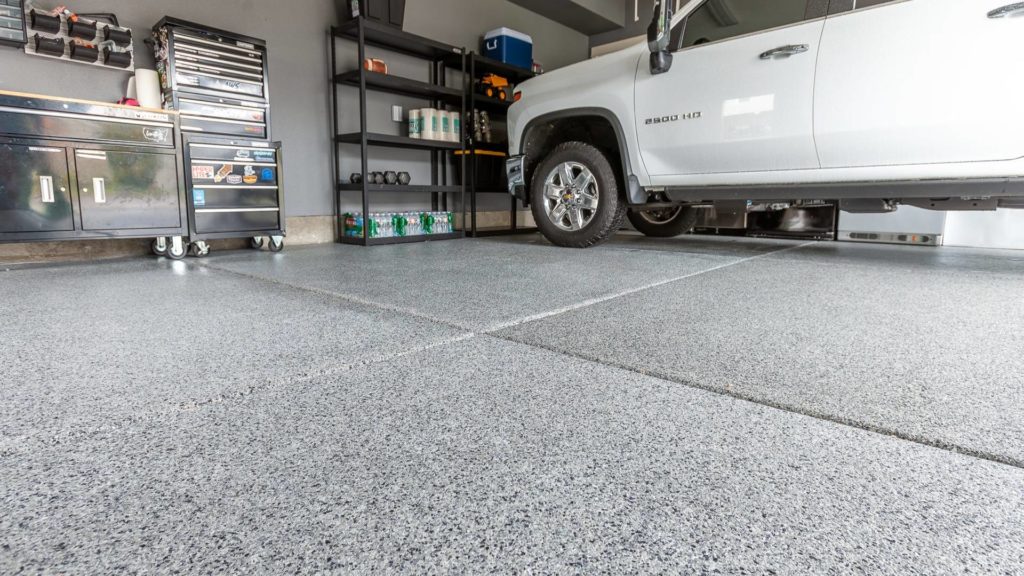
For most garage floors, granite flake is the practical pick and solid color is the design pick. When you’re weighing garage floor coating colors, a flake coating blends colored vinyl chips into the finish, which hides cracks, patches, and everyday dirt while adding grip underfoot. A solid color coating lays down one clean, uniform tone for a sleek, modern look, which is why you see it in showrooms, gyms, and some commercial spaces. Both use the same durable coating systems, so the choice comes down to how you use the space and how you want it to look. For a garage in Portland, OR or Vancouver, WA, where floors deal with plenty of tracked-in rain, that decision is worth getting right. Below you’ll find a side-by-side breakdown so you can decide with confidence.
Granite flake vs. solid color at a glance
Here’s the quick comparison before we get into the detail:
| Feature | Granite Flake | Solid Color |
|---|---|---|
| Look | Textured, speckled, multi-tone | Smooth, uniform, single tone |
| Hides flaws and dirt | Very well | Shows more |
| Slip resistance | Higher, from the flake texture | Lower unless an anti-slip additive is used |
| Best for | Home garages, patios, high-traffic floors | Showrooms, modern spaces, branded interiors |
| Color options | Wide range of blends | Wide range of single colors |
Appearance and design
Granite flake coatings get their look from thousands of colored vinyl chips broadcast into the coating, then locked under a clear topcoat. The result resembles natural stone or terrazzo, adding depth and visual variation across the entire floor. You can choose from subtle gray and neutral blends or bolder combinations featuring blue, tan, or earth tones. If you want to compare different styles, explore our granite flake color chart.
Solid color coatings provide a smooth, uniform finish with one consistent tone from wall to wall. Popular shades like battleship gray and charcoal create a clean, professional appearance, while lighter colors can make a garage or workspace feel brighter and more open. If you prefer a minimalist floor that highlights your vehicles, equipment, or displays, a solid color epoxy garage floor offers a sleek and modern aesthetic.
Hiding cracks, patches, and everyday dirt
This is where a lot of homeowners land on granite flake. The texture and color variation break up the surface visually, so hairline repairs, old patchwork, and the tire marks and dust that come with garage life blend right in. Between cleanings, a flake floor simply looks tidier.
A solid color floor gives you nowhere to hide. Because the tone is uniform, small imperfections and settled dust are easier to spot, and footprints or a bit of dropped soil stand out more on a single flat color. That’s fine in a low-traffic or purely visual space, and it’s worth knowing before you commit if the floor sees daily use.
The short version: if your garage does real work, an epoxy flake floor coating keeps it looking good with less effort. If your space is about presentation, solid color makes a stronger visual statement.
Slip resistance and safety
The flake itself adds a subtle texture that improves traction, which matters in a Pacific Northwest garage where you’re tracking in rain much of the year — Portland gets roughly 37 inches of rain a year on average, most of it between November and March. That built-in grip is one reason granite flake is a common pick for home garages and outdoor surfaces like patios.
A solid color coating is smoother by nature, so it can feel slicker when wet. That’s easy to solve. An anti-slip additive can be worked into the topcoat to bring traction up to where you need it, so a solid color floor can still be safe in a spot that occasionally gets damp. You just have to plan for it rather than assume it. For reference, OSHA recommends a static coefficient of friction of 0.5 or higher as a general benchmark for slip-resistant walking surfaces, which is a useful yardstick if traction is a top priority for your space. For a deeper look at traction-focused options, see our guide to slip-resistant concrete coatings for high-traffic areas.
Durability and maintenance
Durability comes mostly from the coating system and the prep underneath, not from whether you chose flake or solid. When the concrete is properly ground and the layers are installed correctly, both finishes resist hot tire pickup, chemicals, abrasion, and impact, and both hold up for years. You can read more about the systems we install on our coating systems page, and see how these finishes stack up against other materials in our comparison of polyaspartic vs. epoxy garage floor coatings.
Cleaning is where flake pulls ahead day to day. A flake floor forgives dust and light debris until your next wash, while a solid color floor shows the same debris sooner and rewards more frequent sweeping if you want it looking its best. Both wipe clean easily, so this is about how often you notice mess, not how hard it is to remove.
What each option garage floor coating colors costs to install
Flake and solid color coatings land in a similar range for a typical garage, since the labor, surface prep, and topcoat are comparable. Your final number depends far more on square footage, the condition of your existing slab, and how much crack repair or grinding it needs than on the color style you choose. The most reliable way to know is an on-site look at your actual floor, which we’re glad to provide.
When to choose granite flake
Granite flake is usually the right call when you want a floor that stays looking clean between washes, hides existing repairs and normal wear, and gives you a bit more grip underfoot. It’s the popular choice for home garage floor coatings around Portland, OR and Vancouver, WA and nearby areas, and it carries over well to patios where traction matters. If you want the full rundown on this finish, see our granite flake floor systems page.
When to choose solid color
Solid color makes sense when the look is the point. A uniform, modern floor suits showrooms, retail and office spaces, home gyms, and garages where you want a clean, minimal backdrop. It also works when you want the floor color to match a brand or a specific design scheme. Pair it with an anti-slip additive in any area that might get wet, and you get the sleek finish without giving up safety. Our residential coating services page has more on how we tailor finishes to the way you actually use the space.
Get your floor coating designed to fit how you live
Not sure which finish suits your space? We’ll walk your floor, talk through how you use it, and show you real blend and color samples from our color chart so you can picture the result before anything is installed. As a family owned and operated company that has coated floors through plenty of wet Pacific Northwest seasons, we build every floor to be durable, good looking, and easy to clean.
Call (971) 247-9844 or request a quote to get started. We’re based in Portland, OR and serve the Portland metro, Vancouver, WA, and SW Washington and nearby areas.