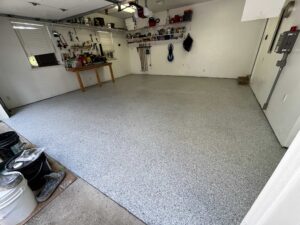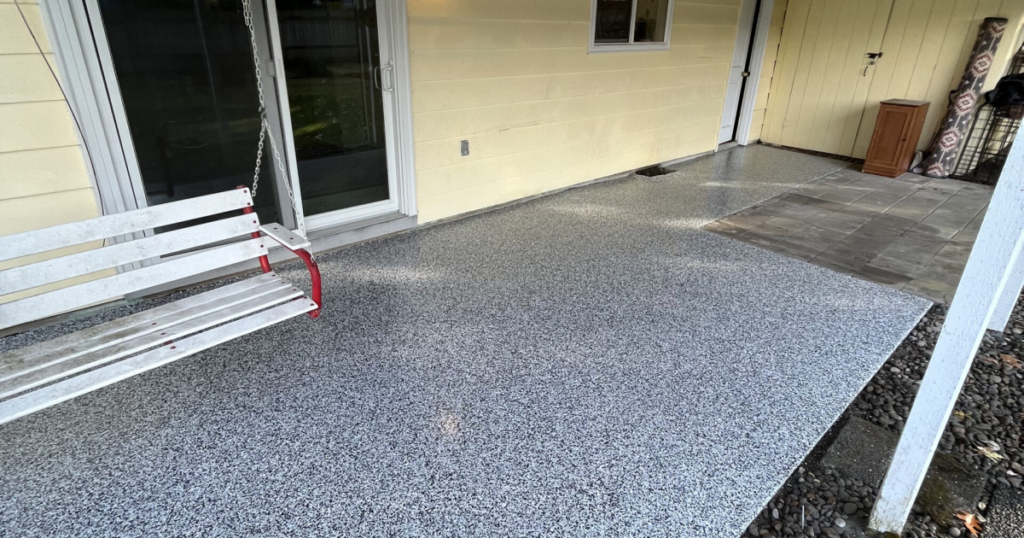
Quick answer: A Camas, WA homeowner had us coat a 320 sq ft backyard patio that had a decade of moss, sun-bleaching, and hairline cracks. We installed a 100% polyurea basecoat, broadcast granite flake, and a UV-stable polyaspartic topcoat in a single day. The patio was usable the next morning, back to full furniture and grill use in 48 hours, and the annual moss battle was over for good.
This patio coating project in Camas, WA is a good example of what most jobs like it look like across Camas and SW Washington: an older slab, PNW moss and weathering, cracks at the joints, and a homeowner who wanted the backyard to feel like a finished extension of the house. Here is how it went.
Project at a Glance
| Detail | Info |
|---|---|
| Location | Camas, WA |
| Project type | Residential backyard patio |
| Approximate size | 320 sq ft |
| System installed | 100% polyurea basecoat, broadcast granite flake, UV-stable polyaspartic topcoat |
| Install time | 1 day |
| Return to service | Foot traffic next morning, full furniture at 48 hours |
The Starting Point
The slab was structurally sound but visually worn out. A decade of Camas weather had taken its toll: moss had crept inward from the shaded north edge, the south-facing center had faded to a chalky gray from sun exposure, and the cracks at the control joints had widened just enough to catch debris. Moss on patios and walkways is a known slipping hazard in wet, shaded climates, and OSU Extension specifically flags removal from high-traffic surfaces for that reason. The homeowner had pressure-washed the patio every spring for years and watched it look good for about three weeks before the moss came back. Sealers had been tried twice and worn off both times.
What the Homeowner Wanted
Three priorities came up during the in-home estimate:
- A finished outdoor surface that looked like part of the house instead of a tired slab
- An end to the annual moss battle
- Slip resistance for wet PNW shoulder seasons, especially with kids running between the patio door and the yard
A polyurea and polyaspartic flake system covered all three, and it’s why this kind of concrete patio coating outperforms a sealer for a slab with this much wear.
The Coating System We Installed
For this project we installed our standard outdoor flake system. Each layer plays a specific role on a PNW backyard patio:
- Polyurea basecoat, 100% solids, sourced direct from the manufacturer. Bonds chemically and mechanically to ground concrete and stays flexible through Camas freeze-thaw cycles.
- Granite flake, broadcast in a medium tan and gray blend chosen to complement the home’s siding. Hand-broadcast to refusal across the entire surface for slip resistance and a finished-room appearance.
- Polyaspartic topcoat, UV stable, sealed against moss and lichen, and resistant to the chlorine the homeowner uses to spot-clean the patio after dog accidents.
Day-of Install Walkthrough
Everything below happened on a single install day with our trained crew on site:
- Diamond grinding the slab. We ground the entire 320 sq ft surface with HEPA-filtered grinders to expose fresh concrete pores. The grinding also removed every trace of the old sealers, moss roots, and weathered surface layer. See how we approach surface preparation on our process page.
- Crack and joint repair. Hairline cracks and the control joints got cleaned out and filled with flexible polyurea filler so the slab moves as one piece under the new coating. More on concrete crack repair on our blog.
- Polyurea basecoat application. Rolled across the prepared slab with the basecoat keying into the open concrete pores.
- Flake broadcast. While the basecoat was still wet, the crew hand-broadcast the tan and gray flake blend across the entire patio until the surface was fully covered.
- Scrape and vacuum. Once the basecoat set, we scraped the high points and vacuumed loose flake to leave a smooth, uniform texture.
- Polyaspartic topcoat. A UV-stable clear polyaspartic was rolled over the flake, sealing the surface and producing the finished slip-resistant outdoor finish.
By late afternoon, the homeowner had a finished patio ready for next-day use.
The Result
The patio went from a weathered, moss-edged eyesore to a finished outdoor surface that reads as a real extension of the home. The homeowner can sweep it in a few minutes, hose it down occasionally, and skip the annual pressure-wash ritual entirely. The sealed surface gives moss and lichen no place to take hold. The flake texture grips wet shoes during PNW rain. The polyaspartic top stays clear under Camas summer sun instead of yellowing the way the old sealers did.
The biggest functional win on a Camas patio is the end of the moss problem. A sealed flake surface gives PNW moss nothing to grip, so the annual pressure-wash routine goes away from day one.
Why This System Works for Camas Backyard Patios
Camas sits in the heart of the moisture and freeze-thaw zone that defines SW Washington outdoor surfaces. North-facing patios stay shaded and damp through much of the year. South-facing surfaces bake under direct summer sun. Winter cycles between rain, frost, and thaw enough times to crack rigid coatings, a process peer-reviewed research on concrete freeze-thaw damage describes as one of the most severe threats to concrete durability in cold, wet regions.
The polyurea and polyaspartic flake system handles all of it:
- Polyurea flexes with the slab through Camas freeze-thaw cycles
- Polyaspartic stays clear under direct sun without yellowing or chalking
- Flake adds traction for wet patios during October through May
- Sealed surface eliminates moss, lichen, and weed growth at joints
- Chemical resistance handles pool splash, fertilizer drift, and outdoor cleaning products
The same concrete patio coating approach works equally well across the rest of Camas and SW Washington, from patios in Vancouver.
Frequently asked questions
How long does a patio coating installation take in Camas, WA? Most residential patios, including this 320 sq ft project, are ground, repaired, coated, and topcoated in a single day, with the surface ready for foot traffic the next morning.
Will a coated patio stop moss from coming back? Yes. A sealed, non-porous surface gives moss, lichen, and algae nothing to grip, which ends the cycle of pressure-washing and regrowth that sealers alone don’t solve.
Is a polyurea and polyaspartic system better than a concrete sealer for a patio? For a patio dealing with moss, sun fade, or cracking, yes. A sealer is a thin, temporary layer, while this system is a bonded, multi-layer coating built to handle PNW freeze-thaw and UV exposure long term.
Does a patio coating hold up to Camas winters? Yes. The polyurea base stays flexible through freeze-thaw cycles instead of cracking, and the sealed surface keeps water from soaking in and expanding when it freezes.
How much does a patio coating cost for a project this size? Cost depends on square footage, slab condition, and flake selection. We walk every patio in person and provide a written quote, since a 320 sq ft slab in good shape prices differently than one needing extensive crack repair.
Want a Patio Coating Like This in Camas, WA?
Complete Coatings NW is a family-owned concrete coatings company serving Camas, WA and the surrounding Clark County and Portland metro areas. Every patio coating install includes full diamond grinding, our 100% polyurea basecoat, vinyl flake broadcast for slip and color, and a UV-stable polyaspartic topcoat.
Call (971) 247-9844 or request your in-home estimate and we will walk your patio, talk through flake color options, and hand you a written quote. Curious how this compares to a paver patio? See our breakdown of patio coatings vs. pavers in the Pacific Northwest. Or browse more finished projects in our project gallery.