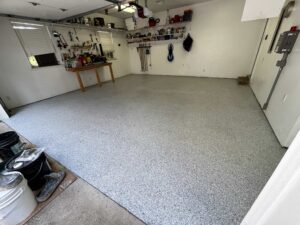
Removing old epoxy from a garage floor typically requires mechanical grinding to strip away the existing coating and expose the concrete underneath. While chemical strippers and scraping may work on certain thin or damaged coatings, diamond grinding is often the most reliable option for removing well-bonded epoxy from an entire garage floor.
For homeowners in Portland, OR, Vancouver, WA, and surrounding areas, epoxy removal can be a challenging DIY project. Renting equipment may reduce labor costs, but professional removal can save time and provide the properly prepared concrete surface needed for a new coating.
Professional epoxy floor removal is sometimes estimated at $2 to $5 or more per square foot, although this is a preliminary budgeting range, not a verified local market average. Actual pricing depends on the existing coating, concrete condition, and preparation required.
If your garage floor is peeling, chipping, or showing signs of coating failure, Complete Coatings NW provides professional epoxy floor removal services throughout the Portland metro area and Southwest Washington.
Why Is Epoxy So Difficult to Remove From Concrete?
Epoxy coatings are designed to bond tightly to prepared concrete, creating a hard, protective surface that withstands regular use.
However, the same properties that make a properly installed epoxy floor durable can make it difficult to remove.
Once cured, epoxy forms a hardened coating that generally cannot be removed from an entire garage floor using basic household cleaning products.
Several factors make epoxy removal challenging:
- Strong adhesion: Properly installed epoxy bonds tightly to the concrete surface.
- Coating thickness: Multiple layers or high-build epoxy systems can require more grinding.
- Surface texture: Uneven concrete and existing cracks make complete removal more complicated.
- Previous repairs: Patches, fillers, and older coating layers may require different removal techniques.
- Limited access: Corners, edges, and areas near walls require additional attention.
If the existing epoxy is already peeling or separating from the concrete, some loose sections may be easier to remove. However, firmly bonded areas often still require mechanical grinding.
For floors showing significant deterioration, professional floor coating removal helps ensure the old material is removed before a replacement system is installed.
How to Remove Epoxy From a Garage Floor
There are several ways to remove epoxy from concrete, but the most effective method depends on the type of coating, its condition, and the size of the floor.
1. Diamond Grinding
Diamond grinding is one of the most common methods for removing epoxy from residential garage floors.
A concrete floor grinder uses diamond tooling to abrade the existing coating and expose the concrete underneath.
This method is especially useful because it can remove the old epoxy while creating a surface profile suitable for a replacement coating.
Benefits of diamond grinding include:
- Removes firmly bonded epoxy coatings.
- Works across most residential garage floor sizes.
- Helps eliminate residual coating material.
- Prepares concrete for compatible floor coating systems.
- Provides greater control over surface preparation when operated correctly.
The process requires suitable equipment, experienced handling, and effective dust collection to help prevent unnecessary concrete damage and airborne dust exposure.
2. Shot Blasting
Shot blasting is another mechanical method used to remove coatings from concrete.
This process uses specialised equipment to propel small steel particles against the floor, removing surface materials and creating a textured concrete profile.
Shot blasting can be effective for larger commercial and industrial floors.
However, for a typical residential garage, diamond grinding is often the more practical approach because of equipment size, access requirements, and the need to work around walls and corners.
3. Chemical Epoxy Strippers
Certain chemical products are formulated to soften or remove specific epoxy coatings.
However, their effectiveness depends on the coating chemistry, thickness, condition, and product compatibility.
Chemical removal can also involve hazardous fumes, skin contact risks, ventilation requirements, and disposal concerns.
For a fully bonded garage floor coating, chemical stripping may be less practical than mechanical removal.
Always follow product instructions and safety information. Avoid mixing chemicals or applying products without confirming their suitability for the existing coating.
4. Scraping and Hand Tools
Hand scrapers and other manual tools may help remove small areas of epoxy that are already loose or peeling.
However, they are generally inefficient for removing an entire well-bonded garage floor coating.
For most full-garage projects, mechanical removal provides a more consistent result.
Can You Remove Garage Floor Epoxy Yourself?
Yes, removing epoxy from a garage floor can be a DIY project, but it requires appropriate equipment, dust controls, protective gear, and experience operating concrete grinding machinery.
For homeowners considering DIY removal, the main requirements include:
Concrete Floor Grinder
A suitable walk-behind concrete grinder with diamond tooling designed for coating removal is generally required.
Additional handheld equipment may be needed for corners, edges, and areas that a larger grinder cannot reach.
Effective Dust Control
Grinding epoxy from concrete can release hazardous fine dust, including respirable crystalline silica from the concrete.
According to the Occupational Safety and Health Administration (OSHA), concrete grinding requires appropriate dust-control methods, such as compatible vacuum dust collection systems or wet methods, depending on the equipment and work conditions.
An ordinary household vacuum is not a suitable substitute for a purpose-designed dust-control system.
Proper Protective Equipment
Depending on the equipment, exposure conditions, and applicable safety requirements, protective measures may include:
- Properly selected respiratory protection
- Safety glasses or appropriate eye protection
- Hearing protection
- Protective gloves
- Suitable work clothing and footwear
Respiratory protection alone should not be treated as a replacement for effective engineering controls.
Time and Physical Effort
Garage floor grinding can involve hours of repetitive, physically demanding work.
Project duration depends on the coating’s condition, garage size, equipment capability, and operator experience.
Additional time is usually needed for edges, corners, dust cleanup, and checking whether the concrete has been adequately prepared.
For homeowners unfamiliar with concrete grinding equipment or silica dust controls, hiring an experienced professional is generally the safer choice.
How Much Does It Cost to Remove Epoxy From a Garage Floor?
The cost of removing epoxy from a garage floor depends primarily on the floor’s size, the existing coating, equipment requirements, and concrete condition.
For preliminary budgeting, some projects may fall around $2 to $5 or more per square foot for professional removal. This is an illustrative estimate and should not be treated as a confirmed price for Portland or Vancouver.
Estimated Professional Epoxy Removal Costs
| Garage size | Estimated removal cost |
|---|---|
| 1-car garage, 200–250 sq. ft. | $400–$1,250+ |
| 2-car garage, 400–500 sq. ft. | $800–$2,500+ |
| 3-car garage, 600–750 sq. ft. | $1,200–$3,750+ |
These examples are calculated using the preliminary $2–$5 per-square-foot range. Actual contractor prices, minimum charges, concrete repairs, and preparation work may differ. Estimates do not include a new garage floor coating.
What Affects Epoxy Removal Pricing?
Several factors can influence the final cost.
Coating thickness and adhesion: Thick or strongly bonded coatings can require additional grinding passes and specialised tooling.
Garage size: Larger floors require more labor and equipment time, although minimum charges and economies of scale may affect the price per square foot.
Concrete condition: Cracks, damaged sections, and uneven surfaces may require additional preparation or repairs.
Access and layout: Tight spaces, stairs, corners, and difficult equipment access can increase labor time.
Removal and replacement scope: A project that includes both old coating removal and a new coating installation may be priced differently from removal alone.
For homeowners planning a complete floor replacement, our garage floor coating cost guide explains typical installation pricing and the factors affecting the total investment.
DIY vs. Professional Epoxy Floor Removal
Choosing between DIY and professional epoxy removal depends on your budget, available time, experience, and the condition of your garage floor.
| Factor | DIY epoxy removal | Professional removal |
|---|---|---|
| Equipment | Must be rented or purchased | Commercial equipment supplied |
| Labor | Homeowner performs the work | Experienced crew |
| Dust control | Must be arranged and operated correctly | Appropriate controls should be included |
| Project time | Depends heavily on experience | Often more efficient |
| Concrete preparation | Depends on operator skill | Professional surface preparation |
| Upfront cost | Rental, tooling, safety equipment, and disposal | Contractor’s quoted price |
DIY removal may be reasonable for someone experienced with concrete grinding equipment and appropriate safety controls.
However, professional removal is often more practical when the garage has multiple coating layers, damaged concrete, or a replacement coating planned.
Complete Coatings NW provides floor demolition and removal services, including removal of worn coatings and preparation for new floor finishes.
Why Proper Concrete Preparation Matters After Epoxy Removal
Removing the old epoxy is only part of the project.
Before installing a new garage floor coating, the underlying concrete must be evaluated and prepared to support proper adhesion.
If residual epoxy, oil contamination, loose concrete, or moisture issues remain, the replacement coating may experience problems such as peeling, bubbling, or premature separation.
A professional surface preparation process may include:
- Inspecting the concrete: Identify cracking, damage, previous repairs, and potential moisture concerns.
- Removing the old coating: Mechanically remove the existing epoxy and remaining residue.
- Repairing damaged areas: Address appropriate cracks, chips, and surface defects.
- Checking surface conditions: Evaluate whether the slab meets the requirements of the replacement system.
- Preparing the concrete profile: Create a suitable surface for the next coating to bond.
Proper preparation is especially important when installing a new polyurea or polyaspartic garage floor coating.
What Is the Best Coating After Removing Old Epoxy?
Once the old epoxy has been removed and the concrete is properly prepared, homeowners can explore replacement coating systems.
For residential garages in Portland, OR, and Vancouver, WA, polyurea and polyaspartic systems are popular options because they provide durable finishes, decorative colors, and relatively fast curing times.
At Complete Coatings NW, our garage floor coating services use a multi-layer system designed for residential garage floors.
Polyurea Basecoat
A professionally applied polyurea basecoat creates the foundation for the coating system and provides adhesion to properly prepared concrete.
Decorative Flake Finish
Decorative flakes add color, texture, and visual interest, helping turn an unfinished garage into a cleaner, more attractive space.
Polyaspartic Topcoat
A clear polyaspartic topcoat protects the decorative finish and helps resist common stains, abrasions, and everyday vehicle traffic.
When correctly installed and maintained, these systems can offer durable performance. However, coating longevity still depends on concrete conditions, product selection, preparation, and use.
Frequently Asked Questions About Garage Floor Epoxy Removal
What is the easiest way to remove epoxy from a garage floor?
For a fully bonded epoxy floor, mechanical diamond grinding is generally one of the most effective removal methods. Although loose sections may be scraped away, large areas typically require specialised grinding equipment.
Can you remove epoxy from concrete without grinding?
Some epoxy coatings may respond to compatible chemical removers or other mechanical methods. However, grinding is often the most practical approach for removing an entire firmly bonded garage floor coating.
How long does it take to remove epoxy from a garage floor?
The timeline depends on the floor size, epoxy thickness, coating adhesion, equipment, and concrete condition. Professional removal of a standard garage may be completed within a working day, while difficult projects can take longer.
Can I apply a new garage floor coating over old epoxy?
In certain cases, a compatible coating can be applied over an existing finish that is sound and properly prepared. However, peeling, poorly bonded, or failing epoxy should generally be removed before applying a replacement coating.
Does grinding epoxy damage concrete?
Improper grinding can gouge or damage concrete. When performed correctly with appropriate equipment and tooling, grinding removes the existing coating while preparing the surface for a new finish.
Is epoxy removal dangerous?
Concrete grinding can release respirable crystalline silica dust, which poses serious health risks when inhaled. The National Institute for Occupational Safety and Health (NIOSH) explains why effective dust extraction and suitable engineering controls are important during concrete grinding.
Should I remove peeling epoxy or coat over it?
If the existing epoxy is peeling or separating from the concrete, removing the failed material is generally the more reliable option. Applying a new coating over a poorly bonded surface can lead to another coating failure.
Professional Garage Floor Epoxy Removal in Portland, OR and Vancouver, WA
Removing old epoxy requires more than stripping away the visible finish. The concrete underneath must also be properly evaluated and prepared for whatever comes next.
Complete Coatings NW provides professional epoxy removal and concrete floor preparation for homeowners throughout Portland, OR, Vancouver, WA, and surrounding communities in the Pacific Northwest.
Whether your garage has peeling epoxy, worn coatings, or an outdated finish you want to replace, our team can help you assess the existing floor and explore the appropriate removal and replacement options.
We can handle the removal process and install a new coating system, helping simplify your garage floor improvement project.
Ready to Remove Your Old Epoxy Garage Floor?
If your current epoxy floor is peeling, cracking, or showing signs of wear, Complete Coatings NW can help you prepare for a fresh start.
Our family-owned and operated company provides professional epoxy floor removal, surface preparation, and garage floor coating installation throughout the Portland metro area and Southwest Washington.
Call (971) 247-9844 to discuss your garage floor and request an estimate.
Explore our professional epoxy removal services to learn more about preparing your concrete for a new coating.