Quick answer: In the polyaspartic vs epoxy comparison, polyaspartic cures faster, stays clear under sunlight, flexes with the slab, and resists hot tire pickup. Epoxy has a lower up-front cost but yellows in UV, cracks under slab movement, and takes days longer to install. Most professionally installed garage floors today use a hybrid system, with a polyurea or epoxy base and a polyaspartic topcoat, because that combination delivers the best of both.
Below is a real breakdown of the chemistry, the practical differences, and which makes more sense for a Pacific Northwest garage.
Quick Comparison
| Factor | Epoxy | Polyaspartic |
|---|---|---|
| Install time | 3 to 5 days | 1 day |
| Foot traffic ready | 12 to 24 hours | 4 to 6 hours |
| Vehicle traffic ready | 5 to 7 days | 24 to 48 hours |
| UV stability | Yellows in 6 to 18 months | UV stable, stays clear |
| Flexibility | Rigid, more brittle | Flexible, absorbs movement |
| Hot tire pickup | Common failure point | Strongly resistant |
| Lifespan (residential) | 5 to 10 years | 10 to 20 years |
| Up-front cost | Lower | 20 to 40 percent more |
| Best use | Climate-controlled, no sun | Garages, patios, pool decks |
What Is Epoxy?
Epoxy floor coating is a two-part resin system. You mix an epoxy resin with a hardener, the chemical reaction kicks off, and the mixture cures into a hard, dense polymer that bonds to prepared concrete. Epoxy has been used on garage floors, warehouses, kitchens, and factory slabs for over 50 years. It is the technology most homeowners think of when they hear “garage floor coating” and the technology behind nearly every box-store DIY kit.
Epoxy works. It builds film thickness well, resists most household chemicals, and creates a glossy finish at a relatively low up-front cost. The trade-offs come from its chemistry. It cures slowly, which means days of downtime. It is rigid, which means it can crack when concrete moves. And it has poor UV stability, which means any direct sunlight will turn a white or light epoxy floor amber within a year, a process Composite Envisions explains in detail: UV exposure breaks down the resin’s chemical structure, forms free radicals, and those radicals bond with oxygen to cause the yellowing.
What Is Polyaspartic?
Polyaspartic floor coating is an aliphatic polyurea, a newer chemistry developed in the 1990s. Like epoxy, it is a two-component system that cures by chemical reaction. Unlike epoxy, it cures in 30 minutes to an hour per coat, stays UV stable, and remains flexible after curing. It was originally engineered for industrial uses like coating bridges, pipelines, and steel structures where toughness and weather exposure were both required.
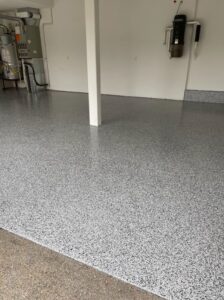
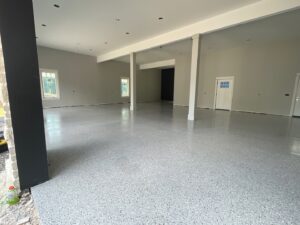
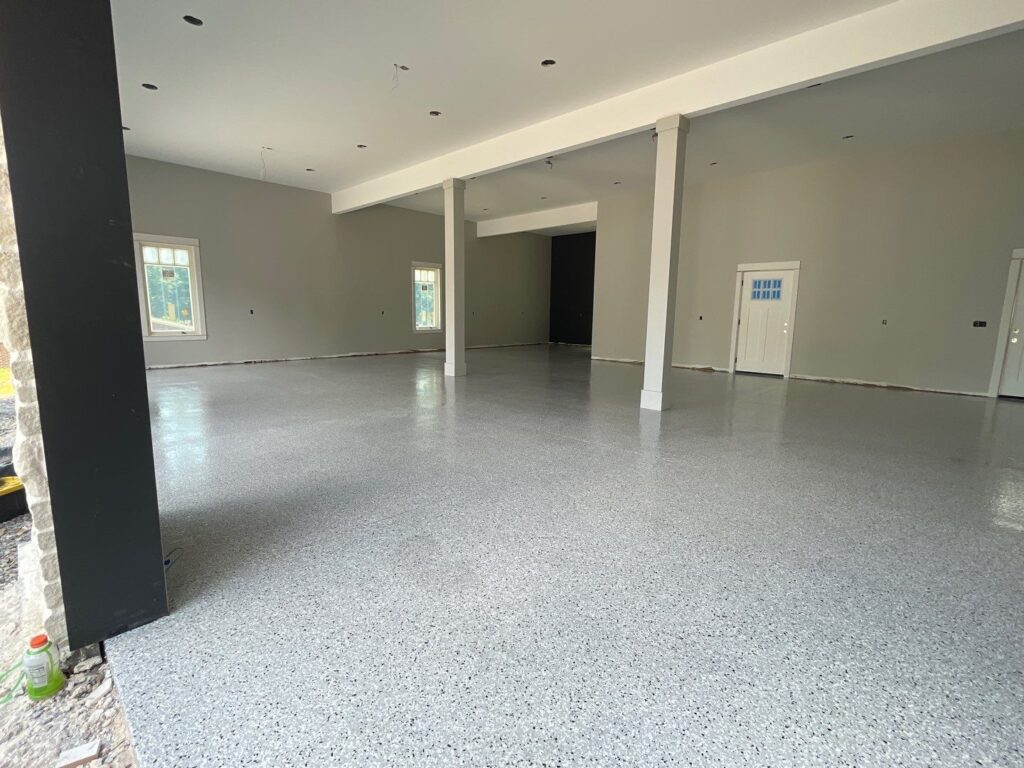
Polyaspartic can be used as a primer, body coat, or topcoat. In residential garage work, the most common professional setup is a hybrid: a polyurea basecoat bonded to ground concrete, vinyl flake broadcast for color and traction, and a polyaspartic clear topcoat that locks everything in and handles UV exposure.
Key Differences That Actually Matter
Skip the marketing. These are the differences that show up in a real garage.
1. Cure Time and Install Speed A multi-coat epoxy system needs 24 hours of cure time between coats and another full week before vehicles can return. Plan on three to five working days minimum, with the garage out of service for around ten days total.
Polyaspartic recoats in 30 minutes to an hour. A professional crew preps in the morning, applies the basecoat and flake by midday, hits the topcoat in the afternoon, and you are walking on the floor by evening. Vehicles return at 24 to 48 hours.
Real-world impact: a polyaspartic system gets your garage back nine days faster than a multi-coat epoxy build.
2. UV Stability and Yellowing This is the difference most homeowners regret learning the hard way. Epoxy yellows under UV light. A white or light gray epoxy floor with a south-facing garage door, windows, or any direct sun exposure will visibly amber within 6 to 18 months. The protection is still there, but the color is shot, and the area under the parked car stays its original shade so the contrast is obvious.
Polyaspartic is UV stable. It does not yellow, chalk, or lose clarity from sun exposure. For any garage where the door opens during the day, this alone settles the topcoat decision.
3. Flexibility and Cracking Concrete moves. Slabs expand, contract, and settle through every freeze-thaw cycle and every summer warm-up. A coating that cannot move with the slab will crack at the joints and propagate from there.
Epoxy is hard but rigid. Polyaspartic is hard and flexible. That flexibility lets it absorb micro-movement without cracking, which matters in any climate with real temperature swings.
4. Hot Tire Pickup Hot tire pickup happens when warm tires from a summer drive park on a coated floor and the heat softens or grabs the coating, lifting it when the car pulls out. It is the single most common epoxy failure on a daily-driver garage. Lower-solids epoxies and DIY kits are most vulnerable.
Polyaspartic has stronger heat tolerance and a harder cured surface. Hot tire pickup on a properly installed polyaspartic system is rare. A polyurea basecoat with a polyaspartic topcoat is the standard fix.
5. Abrasion and Impact Resistance Both coatings handle normal foot traffic and rolling tools. Where polyaspartic pulls ahead is impact resistance. Drop a wrench or a heavy tool on a brittle epoxy floor and it can chip. The same drop on a flexible polyaspartic surface usually leaves a scuff that wipes off. In commercial and warehouse settings, polyaspartic’s edge in standardized abrasion testing matters more. In a residential garage, both perform well, with polyaspartic the safer pick.
6. Lifespan Professionally installed epoxy lasts 5 to 10 years in a residential garage. DIY epoxy kits last 2 to 5 years. Polyaspartic systems last 10 to 20 years. The hybrid systems most pros install fall between, typically 8 to 15 years depending on traffic, prep quality, and care.
7. Cost Epoxy has a lower up-front install cost. The polyaspartic vs epoxy cost gap runs real: a pro epoxy job runs less than a polyaspartic system, and DIY kits cost less still. Polyaspartic typically runs 20 to 40 percent more up front for materials and labor.
The math changes over a decade. If you replace a failed epoxy floor at year seven and the polyaspartic is still going at year fifteen, the lifetime cost per year on the polyaspartic is lower. That is before accounting for the prep, removal, and downtime of redoing the floor.
Which Is Better for a Pacific Northwest Garage?
In the polyaspartic vs epoxy decision for this climate specifically, the PNW is rough on coatings. Wet winters push moisture up through the slab. Freeze-thaw cycles flex the concrete, a mechanism peer-reviewed research on concrete freeze-thaw damage describes as one of the most severe threats to concrete durability in cold, wet regions. Open garage doors let summer sun bleach UV-sensitive products. Salt and grit get tracked in by tires through October and April.
For a Vancouver, Portland, or anywhere-in-between garage, the failure modes that matter most are:
- UV yellowing from sun through the open door
- Hot tire pickup from summer driving on warm pavement
- Cracking and delamination from freeze-thaw cycling, a risk our rainy Portland durability post covers in more depth
- Moisture-related adhesion failure from concrete vapor
A polyaspartic topcoat handles UV and tire heat. Polyurea or polyaspartic basecoats flex with the slab through freeze-thaw. Proper diamond grinding for surface prep and moisture testing handle the rest. Pure epoxy on a PNW garage that sees sun and daily driving is asking for the floor to amber, peel, or crack within a few years.
What We Install and Why
For most residential garage floor coating projects, we install a three-layer hybrid system that takes the best of each chemistry:
- 100% polyurea basecoat sourced direct from the manufacturer. Bonds chemically and mechanically to ground concrete and stays flexible. This is what holds the entire floor down for the long haul.
- Vinyl granite flake broadcast to refusal into the wet basecoat. Adds color, hides everyday dust, and creates the finished-room look most homeowners want.
- UV-stable polyaspartic topcoat. Locks in the flake, resists yellowing from sun through the open door, handles hot tire heat, and creates the easy-clean surface you actually live with day to day.
Before any of that goes down, we diamond grind the slab to open the concrete pores. This stack installs in a single day, returns to vehicle traffic at 48 hours, and is what we would put in our own garages.
Frequently asked questions
Is polyaspartic better than epoxy for a garage floor? For most PNW garages, yes. Polyaspartic cures faster, stays UV stable, resists hot tire pickup, and lasts longer. Epoxy’s main advantage is a lower up-front cost.
Why does epoxy turn yellow but polyaspartic doesn’t? Epoxy’s chemical structure breaks down under UV light and oxidizes, which causes the yellowing. Polyaspartic’s chemistry is inherently UV stable, so it doesn’t go through that reaction.
How much more does polyaspartic cost than epoxy? The polyaspartic vs epoxy cost difference typically runs 20 to 40 percent more up front than a professionally installed epoxy floor. Over a decade, though, the lifetime cost per year often favors polyaspartic since it lasts longer.
Can epoxy handle a garage that gets direct sunlight? Not well. A garage door that opens during the day exposes epoxy to UV, and a white or light epoxy floor will visibly amber within 6 to 18 months in that situation.
Is a hybrid polyurea and polyaspartic system worth it over straight epoxy or straight polyaspartic? For most residential garages, yes. A polyurea basecoat with a polyaspartic topcoat combines flexible, long-lasting bonding with a UV-stable, tire-heat-resistant finish, which is why it’s what most professional installers use.
Get the Right Garage Floor Coating for Your Home
Family-Owned Polyurea and Polyaspartic Systems for PNW Garages
Complete Coatings NW is a family-owned concrete coatings company serving Vancouver, Portland, and the surrounding SW Washington and Portland Metro areas. In the polyaspartic vs epoxy decision, every install we do includes full diamond grinding, our 100% polyurea basecoat, and a UV-stable polyaspartic topcoat.
Call (971) 247-9844 or request your in-home estimate and we will walk your garage, talk through color and flake options, and hand you a written quote.